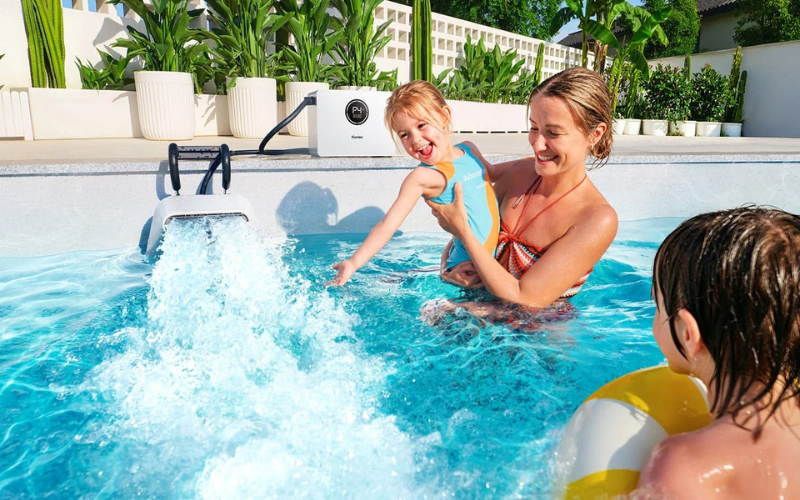
A counter-current pool is useful for more than continuous swimming.
- Start Every Drill at a Lower Current
- Use Kick Sets to Improve Body Position
- Try Streamline Kicking Without a Board
- Pull Sets Shift the Work to the Upper Body
- Single-Arm Freestyle Can Expose Imbalances
- Practice Catch-Up Freestyle for Timing
- Use the Current to Practice Bilateral Breathing
- Add Short Resistance Blocks
- Match the Equipment to the Type of Training
- Build a Simple Technique Session
- Let Technique Decide the Current Strength
It can also create a controlled space for kick sets, pull drills, body-position work, and stroke practice. Because you stay in one area, you can focus on movement instead of counting laps or turning at the wall.
The key is using the right current strength for each drill.
Technique work usually needs less resistance than hard swimming. A current should give you feedback without forcing you to rush.
Here are several ways to build useful drill sessions around moving water.
Start Every Drill at a Lower Current
Do not begin technique work at the strongest setting.
High resistance can hide the movement you are trying to improve. You may kick harder, shorten your stroke, or tense your shoulders just to hold position.
Start with a gentle or moderate current.
You should be able to stay in place without fighting the water.
Once the movement feels controlled, increase resistance slightly.
This approach is especially useful when learning a new drill.
Use Kick Sets to Improve Body Position
Kick training works well against a steady current.
You can hold a kickboard and face the flow. Keep the arms extended and use a controlled flutter kick.
The goal is not simply to kick as hard as possible.
Watch your body position.
Keep the hips close to the surface. Relax the shoulders. Try not to lift the head too high.
If you begin sinking or losing position, the current may be too strong.
You can also perform short kick intervals. Try 20 to 30 seconds at a stronger resistance, followed by an easier recovery period.
This creates a simple leg-strength session without requiring a long pool.
Try Streamline Kicking Without a Board
A kickboard is useful, but it can change body position.
For a more streamlined drill, extend both arms forward and place one hand over the other.
Keep the head between the arms.
Then use a steady flutter kick against the current.
This drill encourages a long body line.
It can also show whether your kick is strong enough to support the hips without help from the arms.
Start with low resistance.
If you can maintain a stable position, increase the current gradually.
Pull Sets Shift the Work to the Upper Body
A pull buoy can reduce the contribution from the legs.
Place it between the thighs and swim using mainly the upper body.
Against a current, this can make the pull phase easier to feel.
Focus on the catch.
Let the hand enter cleanly. Set the forearm before applying pressure. Then finish the pull instead of rushing into the next stroke.
Use a moderate current.
Too much resistance may cause you to shorten the stroke or increase stroke rate.
A good pull drill should help you feel pressure on the hand and forearm without changing your normal movement.
Single-Arm Freestyle Can Expose Imbalances
Single-arm swimming is useful for studying one side at a time.
Keep one arm extended in front of you while the other completes the stroke.
After several repetitions, switch sides.
A steady current provides immediate feedback.
If one arm produces less force, you may begin drifting backward. If your hand crosses the center line, your body may move sideways.
Keep the current relatively gentle.
This is a coordination drill, not a strength test.
You can also use it to practice breathing on your weaker side.
Practice Catch-Up Freestyle for Timing
Catch-up freestyle slows the stroke cycle.
One hand stays extended until the other hand reaches the front.
This gives you more time to focus on alignment and hand entry.
It also encourages a longer body position.
A strong current can make this drill difficult because there is a short period with very little propulsion.
Use lower resistance.
Try to remain stable during the extended phase instead of rushing the next stroke.
As your control improves, increase the current slightly.
Use the Current to Practice Bilateral Breathing
Breathing drills are easier when you do not need to turn every few seconds.
Swim freestyle at an easy pace.
Breathe every three strokes so you alternate sides.
You can also complete one minute breathing only to the left, followed by one minute breathing only to the right.
Watch your head position.
Avoid lifting the face forward.
Rotate with the body and return the head smoothly to the water.
A low to moderate current is usually enough for this drill.
Add Short Resistance Blocks
Technique work does not need to stay easy for the entire session.
Once your movement feels consistent, add short periods of higher resistance.
For example, complete two minutes of relaxed freestyle.
Then increase the current for 20 seconds while trying to maintain the same stroke shape.
Return to the easier setting.
Repeat this several times.
The harder current shows whether your technique remains stable under pressure.
If your stroke suddenly becomes short or rushed, you have found the point where resistance is beginning to affect form.
Match the Equipment to the Type of Training
Adjustability is more important than maximum output for many drill sessions.
A controllable swim jet lets you use a gentle flow for technique and then increase resistance for kick sets or short intervals.
For swimmers who mainly combine drills with regular fitness training, models such as the P200 or X 5 can be sensible options to compare.
Advanced swimmers may prefer the extra training range offered by models such as the P230 or X PRO 10. That additional resistance can be useful for hard kick sets and short high-intensity efforts.
However, even strong swimmers should usually perform detailed technique drills below maximum output.
More resistance is useful only when good movement can be maintained.
Build a Simple Technique Session
A drill workout does not need to be complicated.
Start with five minutes of easy continuous swimming.
Then complete several short drill blocks.
You might perform two minutes of streamline kicking, followed by two minutes of pull work.
Next, complete several single-arm repetitions on each side.
Add a few minutes of bilateral breathing practice.
Finish with four short resistance intervals while trying to preserve the technique you practiced earlier.
Then lower the current and cool down.
This structure can fit into a relatively short session.
Let Technique Decide the Current Strength
Moving water gives useful feedback because mistakes become easy to feel.
A dropped hip creates more resistance.
An uneven pull may push you sideways.
A weak kick may allow the legs to drift.
Use these changes as information.
Do not immediately solve every problem by increasing effort.
Sometimes the better solution is to reduce the current and correct the movement.
Kick, pull, and technique drills work best when resistance supports the exercise rather than dominating it.
With the right current level, a compact home pool can become a useful place to study stroke mechanics, improve body position, and build strength without swimming a single traditional lap.